by G. H.TANSER
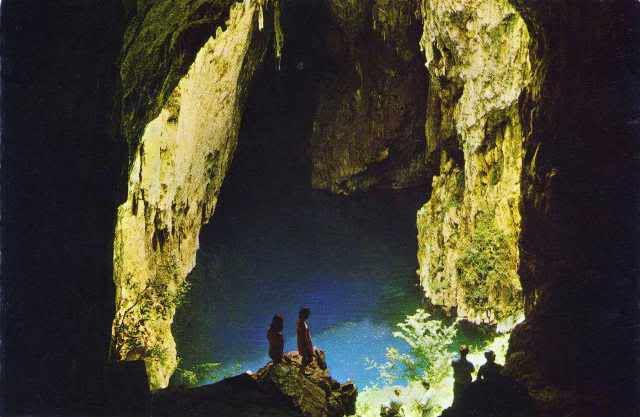
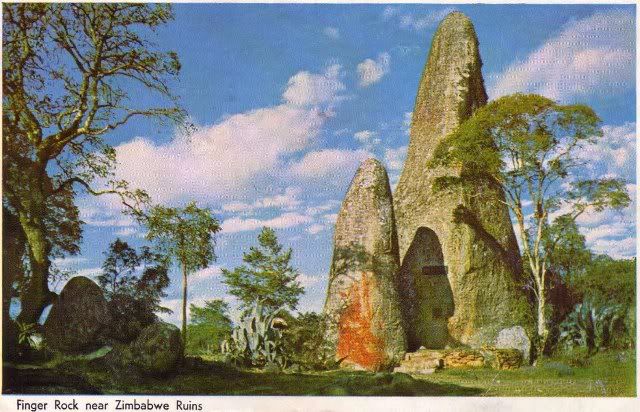
On the other side of the Umfuli River, sixty miles from Salisbury, lie broken kopjies with massive boulders heaped together or standing singly. Among the rocks are open spaces with trees and patches of bush. Where the rocks meet they form deep caves and recesses. It is a fantastic hide-and-seek area in which a person can be invisible from another one within a few feet.
This area had been occupied towards the end of the nineteenth century by chief Mashayamombe whose people put up their wattle-and-daub huts of twenty-five to a hundred to form villages, each governed by a headman. In the gardens below the kopjes, mealies, kafnr-corn, sweet potatoes, pumpkins and monkey-nuts were grown, while there were rice beds in the vlcis. To strengthen the defences of the stronghold stone walls were built between the rocks so that it became an excellent refuge, and a fortress in case of attack.
Early in 1896 the Matabele Rebellion broke out. In April, Kagubi, who was organising the rising of the Shona people against the Europeans, visited Mashayamombe.
Plans were made for the outbreak; Matabele warriors were to be brought northwards and, as soon as these arrived, the Europeans were to be attacked.
On June 15th, 1896, the first murder of a European was committed at Mashayamombe's kraal when the Native Commissioner of Hartley, David Moony, visited the chief to investigate the murder of an Indian storekeeper. On the same day two prospectors were seized, bound hand and foot, and whether dead or alive, thrown into the Umfuli.
On June 21st the Natal troop under Captain J. F. Taylor, which was returning to Salisbury from Fort Charter, attacked Mashayamombe but was beaten off and retired.
Mashayamombe now went into the attack. His forces surrounded Hartley Hill and prevented any communication with the outside world, until the laager was relieved by a patrol under Captain Hon. C.J. White on July 22nd.
By August 1896, a small force of Mounted Infantry had arrived in Rhodesia. This Imperial unit under Lieutenant Colonel E. A. H. Alderson, had left Cape Town for Beira.
After fighting two battles with the rebels on the road from Umtali the troops reached Salisbury. There was a shortage of food for both men and horses so it was not until October 5th that Alderson with a force of 500 Europeans and 100 African troops marched against Mashayamombe.
 A pincer movement was planned. A patrol under Major A. V. Jenner left Fort Charter attacking from the south, driving the rebels from their kraals on to Mashayamombe's. On the night of October 9th Jenner and Alderson made contact by signals and launched a joint attack on the 10th. Sections of the Mounted Infantry, the Salisbury Rifles and the Native Contingent were sent among the kopjes to clear them. The kraals were burned and the enemy disappeared into the caves in which they lay hidden and later emerged elsewhere. Those caves which could be located were blown up but Mashayamombe moved to other strong points on the Umfuli, and though Alderson attacked these, the results were inconclusive and Mashayamombe, having resisted two attacks, settled down again and, when the rains came, planted his gardens.
Alderson was criticised for his effort which left Mashayamombe with the feeling that he could hold out in his kopjes, but Rhodes was desirous that the Imperial troops should be withdrawn and that the newly formed British South Africa Police should take over.
It was decided to establish a fort in Mashayamombe's area. A kopje with precipitous sides opposite to Mashayamombe's and a mile away was selected as a strong point. The kopje named Fort Martin, was occupied by the B.S.A.P. under Captain R.C. Nesbitt on February 20th. Level places on the kopje were used for wattle and daub buildings and for tents; a seven-pounder gun was mounted on the highest point to command Mashayamombe's kraal. A smaller kopje a hundred yards away from the main Fort was occupied by African Police. "Fort Martin", Nesbitt wrote "is very healthy, being splendidly situated, very high... it is impregnable and the best possible place".
References
1. Report on the native disturbances, 1896-97. British South Africa Company.
2. On the South African Frontier. W. H. Brown. Sampson, Low, Marston, 1899.
3. With the Mounted Infantry and the Mashonaland Field Force. E. A. H. Aldcrson. Methuen, 1898.
4. Norton District in the Mashonaland Rebellion, by Col. A. S. I Hickman, M.B.E. in Rhodesiana No. 3, 1958.
5. Pioneer Forts in Rhodesia, by P. S. Garlake in Rhodcsiana, No. 12, September 1965.
6. A Scantling of Time. G. H. Tanser, Stuart Manning, 1965.
7. Revolt in Southern Rhodesia, 1896-97. T. O. Ranger. H

Produced by Rhodesian Breweries Limited for the Rhodesiana.
Printed by Mardon Salisbury
ORAFs records it thanks to Diarmid Smith who made this information available for distribution.
Thanks also to the Rhodesian Breweries, Mardon Printers and the Rhodesiana magazineLabels: Mashayamombe, Rhodesia